

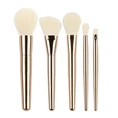


Variant Flame Brush

This is also a smaller brush, the top of the bristles are dispersed, not gathered, generally animal hair. Long than dizzy dyeing, can be used for the bridge of the nose, mountain roots, eyebrows, eye sockets and other places of shadow, can also be used to lighten the triangle under the brow peak.
Tilt to touch the skin and lightly sweep.Do not touch the inner corner of the nose when trimming the root.
Advantages: Small size, best for small areas, strip contouring and highlights. Beginners can directly sweep the earth color onto the eyelid, emphasizing the eyes.
Flat Brush: Blush/Highlight

Flat brushes are less mainstream than tongue and tomato brushes, but they can be used for highlights, blush and even contouring.
For highlights, use an oblique downward swipe from the outer corner of your eye for larger ones, or tap directly onto your cheekbones. The trumpet can be brushed diagonally upward from the eye to the temple.
Advantages: The simplest method can be directly pat along the facial structure, a small number of times, fast hand. Can be used for highlight, blush, contouring. Common tongue blush brush, small area, function limitation, novice. It's good to multitask and take care of details.
Bevel Brush: Contour/Highlight/Blush

With the brushes mentioned above, you've got your base, blush, and highlight done. For the stereoscopic vision of the face, we need to go up the contouring, to open up the layers and light and shade of the face. If you don't know what brush to buy, I first recommend the bevel brush type. (Actually, it works on highlights and blusher too!)
The beveled edge of the face should be brushed gently from the root of the ear to the center of the face. You can apply it to the chin and other areas that need to be emphasized several times, and then sweep it to the center of the face. Pay attention to the contouring area. Too much area will stain your makeup and ruin your original facial structure. Prefer smaller.